In the rapidly evolving world of digital design, choosing the right medium for your message is a critical decision. While both static and animated 3D assets offer a level of depth that 2D graphics cannot match, they serve fundamentally different purposes in a marketing funnel. Understanding the difference between static and animated 3D assets is a factual necessity for designers and brand owners who want to maximize engagement without compromising site performance. Tridimensi.pro provides a curated selection of both types to ensure your digital presence is both visually stunning and technically sound.
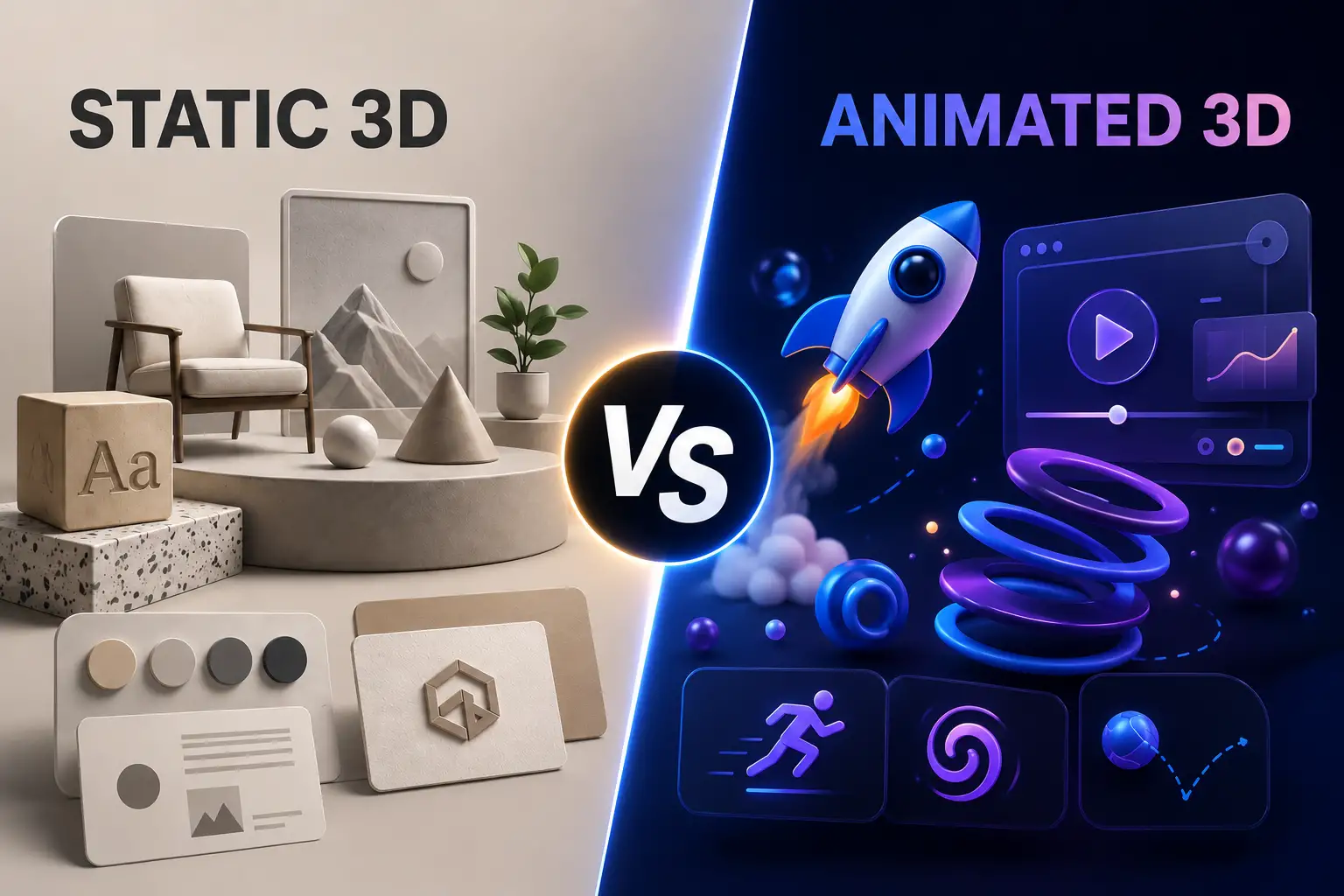
Static 3D assets are high resolution renders that capture a single moment in time with extreme detail. These are ideal for hero sections, product showcases, and high quality print materials. On the other hand, animated 3D assets introduce the element of time and motion, allowing for storytelling and interactive feedback. Choosing between them depends on your primary objective: do you need to establish an immediate, high fidelity brand impression (Static), or do you need to guide a user through a narrative or complex process (Animated)?
The Power of Static 3D Assets for Clarity
Static 3D assets are the workhorses of professional web design. Their primary advantage is clarity and performance. Because a static render such as a 6K abstract background is essentially a high resolution image file, it requires very little processing power from the user’s device. This makes them the perfect choice for websites that need to remain lightning fast while projecting a premium, high tech image. Static objects allow the viewer to appreciate the fine details of texture, light refraction, and geometry without distraction.
Expert designers often use static 3D icons and shapes to anchor a layout. For example, using a static 3D glass shape behind a headline provides a sophisticated focal point that doesn’t compete with the text for the user’s attention. This creates an informational gain by establishing a professional atmosphere instantly. Static assets are also evergreen; they provide a consistent visual foundation that works across all platforms, from mobile apps to physical billboards, without the need for specialized video players or high speed data connections.
Professional use cases for static 3D:
- Hero Sections: Large, high impact renders that set the mood of the entire landing page.
- Content Illustrations: Using 3D objects to represent abstract concepts like security or cloud storage.
- Professional Decks: High resolution PNGs that remain crisp during large scale presentations.
Enhancing Engagement with Animated 3D Assets
Animated 3D assets are designed to solve the problem of short attention spans. Motion naturally triggers a “tracking” response in the human brain, making it nearly impossible for a user to ignore a moving object on a screen. This makes animations like the Liquid Sphere or Futuristic AI Orb incredibly effective for social media ads and landing page hero sections where the goal is to stop the scroll. Animation adds a layer of life to a brand, making it feel dynamic, evolving, and energetic.
The informational gain of animation lies in its ability to show “process.” If you are explaining a complex software feature or a fluid service, a 3D animation can demonstrate the transition from problem to solution more effectively than a series of static images. By using loopable 3D backgrounds, you create a living environment that keeps users on the page longer. This increased dwell time is a positive signal for SEO, indicating to search engines that your content is highly engaging and valuable to visitors.
Strategic advantages of animated 3D:
- Micro interactions: Small 3D movements that respond to user clicks, providing instant feedback.
- Emotional Storytelling: Using fluid, organic motion to evoke specific feelings like calm or innovation.
- Explainer Visuals: Using moving parts to show how a digital product or service actually functions.
Technical Balance and Performance Optimization
An expert approach to 3D design involves knowing when to use each asset type to maintain optimal performance. A common mistake is using heavy 3D animations for every element on a page, which can lead to slow loading times and a frustrating user experience. The most successful websites use a hybrid approach: static 3D assets for the majority of the UI to keep it fast, and targeted 3D animations for high conversion areas like the hero section or the main product feature.
At Tridimensi.pro, we prioritize this technical balance. Our static 3D backgrounds are provided in ultra HD 6K, while our animations are pre rendered and optimized into lightweight formats. This means you can have the “wow factor” of high end motion without the technical pitfalls of unoptimized files. For mobile users, this distinction is vital. A static render will always load faster on a weak connection, while a well optimized animation can provide a premium experience on high speed networks. Being an expert means designing for both scenarios.
Key considerations for performance:
- File Formats: Use WebP or high quality PNGs for static renders; use Lottie or compressed MP4s for animations.
- User Context: Prioritize static assets for content heavy pages and animations for promotional landing pages.
- Loading Strategy: Implement lazy loading for both types to ensure the initial page load remains fast.
Choosing the Best Asset for Your Project
Whether you are looking for the professional stability of static renders or the high energy impact of 3D motion, Tridimensi.pro offers a curated library to fit your needs. From free ultra HD backgrounds to premium animated orbs, we provide the tools to elevate your digital identity.
Tridimensi Asset Selection:
- Entire Store Bundle: $99 (Includes all static and animated assets)
- Static 3D Shapes & Backgrounds: High performance, high fidelity.
- Premium 3D Animations: Narrative driven, high engagement loops.
Ordering Information
Ready to choose the right 3D assets for your brand? You can reach our team directly via email at: [email protected]
Alternatively, you can send a message or DM to our social media channels. Our team is ready to help you decide which static or animated assets will best serve your specific project goals.
FAQ
Which is better for SEO, static or animated 3D?
Both can help! Static assets help with loading speed (a key SEO factor), while animations help with dwell time (how long users stay on your site). An expert designer uses a mix of both to get the best of both worlds.
Are animated 3D assets harder to use than static ones?
Not necessarily. Our animations are provided as easy to use video loops or Lottie files. You can upload them to your website builder or design tool just as easily as you would a static image.
Can I use static renders for my social media?
Yes, absolutely. High quality static 3D renders often stand out more than busy photos because of their clean, professional look. They are perfect for Instagram posts, LinkedIn banners, and Twitter headers.
Do I need to worry about mobile users with 3D animations?
We optimize all our 3D animations specifically for the web. However, for mobile, we usually suggest using one high quality animation at the top of the page and static assets below it to keep the scrolling experience smooth.