SPECIAL OFFER ✦ BUY 2 GET 1 FREE! ✦ ADD 3 PRODUCTS TO YOUR CART, AND THE DISCOUNT APPLIES AUTOMATICALLY!
SPECIAL OFFER ✦ BUY 2 GET 1 FREE! ✦ ADD 3 PRODUCTS TO YOUR CART, AND THE DISCOUNT APPLIES AUTOMATICALLY!
SPECIAL OFFER ✦ BUY 2 GET 1 FREE! ✦ ADD 3 PRODUCTS TO YOUR CART, AND THE DISCOUNT APPLIES AUTOMATICALLY!
SPECIAL OFFER ✦ BUY 2 GET 1 FREE! ✦ ADD 3 PRODUCTS TO YOUR CART, AND THE DISCOUNT APPLIES AUTOMATICALLY!
By 2026, the fields of user interface and user experience design are experiencing a significant evolution propelled by generative artificial intelligence. The emergence of platforms with their best AI tools for UI/UX designers is attributable to various converging trends.
In this article, we will discover how AI revolutionizes UI/UX designs through trends and examples. In addition to the fundamentals and the benefits, you can also explore AI-generated UI designs and AI prototyping tools.
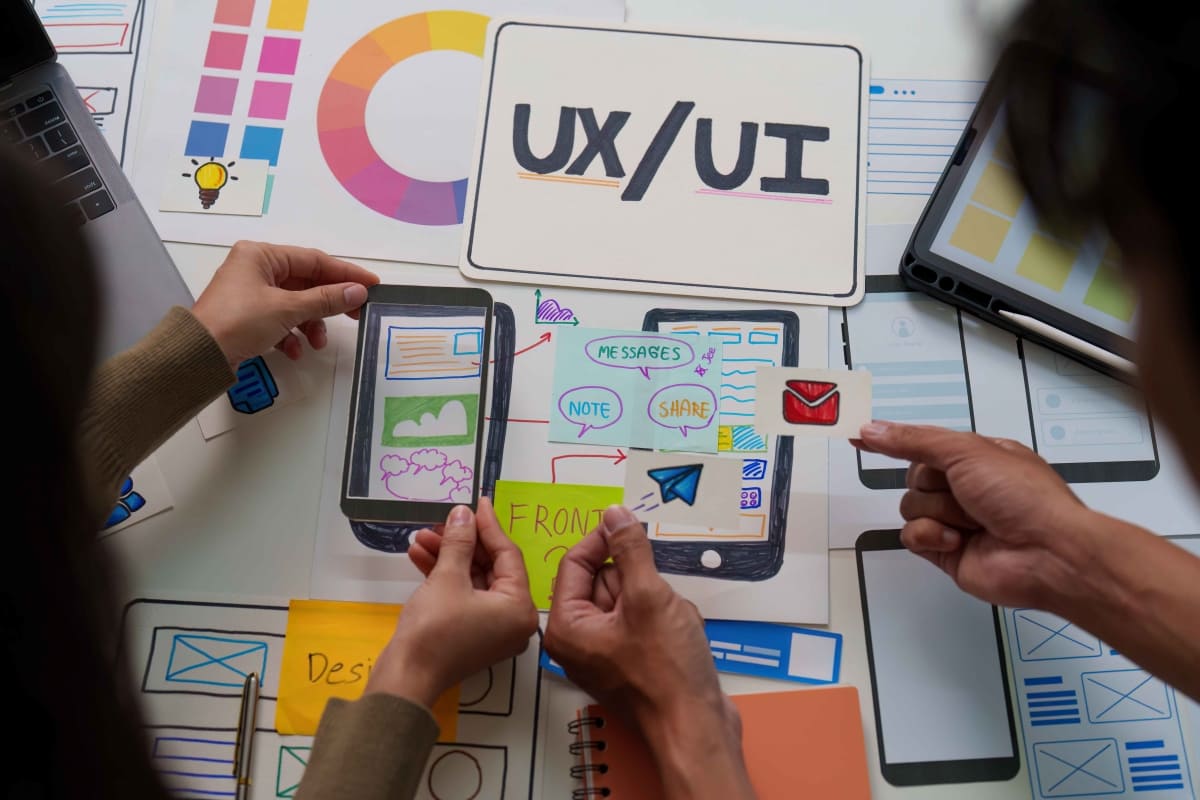
AI Revolution in UI/UX Design
Source : Envato
The Fundamentals
In UX/UI design, various types of AI are especially helpful, including machine learning, natural language processing, and computer vision.
Machine Learning
Among the best AI tools for UI/UX designers, various types of AI are transforming how user interfaces are envisioned and executed. They use machine learning (ML) to examine user data and behaviors, aiding in the personalization of user experiences by tailoring interfaces to personal preferences.
Natural Language Processing (NLP)
NLP enhances user interactions, particularly with the rise of smart chatbots and voice-activated assistants that can understand and respond to customer questions immediately.
Computer Vision
It is another key application of AI in UX/UI design. It is particularly helpful in scenarios like augmented reality (AR) settings where image recognition is required to enhance user interactions.
The Benefits
You can get many advantages from integrating the best AI tools for UI/UX designers. They can mainly enhance not only the design effectiveness but also the total user experience. What is more?
User experience personalization and profiling
User interactions customization by dynamically tailoring user interfaces instantly beyond mere data analysis
Prototyping improvement
Iterative design acceleration
Accessibility improvement
Exclusive design creation
More efficient collaboration among cross-functional teams.
Increased creativity
Some Successful Examples
Several platforms have showcased successful stories related to integrating AI-generated user interface designs.
Personalization enhances user engagement and loyalty. Netflix and Spotify, for instance, employ AI to examine viewing patterns and offer tailored film and music suggestions.
As for customizing user experience, Amazon alters the way items are displayed and organized based on a user’s shopping and viewing history.
Wix’s ADI (Artificial Design Intelligence) platform automates website creation by generating initial prototypes that users can adjust and personalize.
Microsoft’s Seeing AI application suggests functionalities such as voice commands and expanded clickable regions, aiding visually impaired individuals in interacting better with their surroundings.
Project Euphonia (Google) improves speech recognition for people with speech impairments, demonstrating how this technology can develop more inclusive and accessible digital products.
AI-Generated User Interface Designs: The Trends
AI-driven UI designs involve the employment of machine learning algorithms to create, alter, or enhance user interface components throughout the design workflow. It can cover research synthesis and layout creation by prototyping and automatic testing.
If you are considering the best AI Tools for UI/UX designers, it is worth looking at several recent trends in AI-generated user interface designs as well.
Automated Accessibility Auditing
AI tools can scan the whole interface for heading structure errors, missing alt text contrast violations, and gaps in keyboard navigation in minutes instead of the days that manual auditing takes.
Optimization of Predictive UX
The forecasting of user behavior through predictive modeling prior to launch.
End Users’ Generative UI
It is a user-friendly generative interface.
Multimodal and Voice-Integrated Interfaces
Still experimental, interfaces that integrate multiple modes and voice capabilities, as well as gesture and biometric integration.
Artificial Intelligence Prototyping Tools
When we are talking about the best AI tools for UI/UX designers, we cannot leave out Artificial Intelligence prototyping tools. What is it exactly? An AI prototyping tool transforms concepts into interactive product prototypes through artificial intelligence.
In contrast to conventional prototyping software that requires you to manually sketch or move each element, these tools convert your text prompts or screenshots into dynamic UI interfaces. Some go even further by exporting production-ready code in just a few minutes.
AI prototyping tools work best for, among others,
product managers who seek refined presentations (demos) to unify stakeholders
Developers who confirm UI direction prior to coding for production
designers who pursue various layout options prior to making a decision
Teams that do idea testing in advance to minimize costly revisions later
The examples of AI prototyping tools are interchangeable with the following platform tools for AI-generated user interface and user experience designs.
Best AI Tools for UI UX Designers (2026)
Source : Envato
Picking among the best AI tools for AI/UX designers in recent days requires grasping what each platform prioritizes. It will be more about platforms that can facilitate multiple phases of the design process, namely from creating interfaces and wireframes to analyzing user behavior and generating front-end code.
The following are several prominent names for top AI-powered user interface and user experience design tools.
Figma
Figma is a collaborative UI/UX design platform. For AI-generated user interface design, Figma Make creates wireframes based on prompts. As for Artificial Intelligence prototyping tools, Figma is highly ideal for accelerating interaction configuration.
Uizard
Uizard generates full-screen prototypes or UI interfaces based on text descriptions (sketches). In other words, it transforms text, sketches, or wireframes into ready-to-use visual designs. This tool is very popular for creating early-stage prototypes.
UXPilot
It is a powerful AI prototyping tool designed for managing the entire UX workflow – a generative, chat-based workflow – namely from wireframing and user flow generation to usability insights.
Framer (AI)
Its key features are interactive prototyping and AI-driven animated design. The generative AI can create a complete website layout with just a prompt.
Relume (AI)
This tool is ideal for web sitemaps and wireframing. Its strengths are generating UX structures and AI-powered wireframes.
Looking for more? The best AI tools for UI/UX designers you can consider are UiMagic, Galileo AI, Adobe Photoshop, Google Stitch, Maze, Flowstep, Sketch2React, v0 by Vercel, TeleportHQ, Loveable, Khroma, Magic Patterns, and more.
Conclusion
In UX/UI design, AI proves to be highly valuable due to its capacity to examine extensive amounts of data and gain insights from user interactions. Recent trends have showcased AI’s revolutionary impacts on UI/UX design approaches. Visit Tridimensi to explore and employ the best AI tools for UI/UX designers to keep up with the continuously evolving AI.