SPECIAL OFFER ✦ BUY 2 GET 1 FREE! ✦ ADD 3 PRODUCTS TO YOUR CART, AND THE DISCOUNT APPLIES AUTOMATICALLY!
SPECIAL OFFER ✦ BUY 2 GET 1 FREE! ✦ ADD 3 PRODUCTS TO YOUR CART, AND THE DISCOUNT APPLIES AUTOMATICALLY!
SPECIAL OFFER ✦ BUY 2 GET 1 FREE! ✦ ADD 3 PRODUCTS TO YOUR CART, AND THE DISCOUNT APPLIES AUTOMATICALLY!
SPECIAL OFFER ✦ BUY 2 GET 1 FREE! ✦ ADD 3 PRODUCTS TO YOUR CART, AND THE DISCOUNT APPLIES AUTOMATICALLY!
Image generation tools signify one of the largest sectors where AI firms are allocating resources. It is also true with open-source AI image generators. They have created new prospects for artistic expression and visual communication.
Here, you will also encounter terms like “open-weights” and “terms-based” AI. We will break them down, along with some top AI image generators and free self-hosted AI art models, as well as run local AI image generators.
What Does It Mean by Open-Source?
Source : Envato
The term “open” in open-source AI image generators here represents one of the spectrums in contemporary AI that necessitates cautious navigation to evade legal challenges. Nearly all “open source” AI models are essentially “open-weight” ones, allowing for local usage without Application Programming Interfaces(APIs).
Open-Source vs. Open-Weights vs. Terms-Based AI
What distinguishes them? Let’s see the differences based on three key categories – definition, typical license, and commercial safety.
Open-Source (Strict) AI
This category aligns with the Open Source Initiative (OSI) criteria. You will receive the weights, training data, and the “preferred format” to alter the model. It has an OSI-Approved typical license. Its commercial safety is absolute, where you have total freedom to use, study, modify, and share.
Open-Weights AI
It means you can locally download and execute the weights (the brain), but the training data and methodology (recipe) frequently stay proprietary. It has Apace 2.0 or MIT licenses. Its commercial safety is high – typically secure for commercial goods, adjustment (fine-tuning), and redistribution.
Terms-Based (Source-Available) AI
Weights are available for download, but certain legal terms precisely govern the way (how), location (where), and individuals (whom) are permitted to utilize them. It bags Llama Community and Gemma Terms licences. Commercial safety is restricted, frequently encompasses usage limits (e.g., >700 million users), and acceptable usage policies.
Open-Source AI Image Generation Model
So, “open” in open-source AI image generators increasingly refers not only to downloadable weights, but also to the extent to which the system can be inspected, reproduced, and governed.
Again, what you truly need are models with open weights. Weights are basically the “brains” – the downloadable “minds” of the AI. Although the training data and techniques may be proprietary, you receive the crucial aspect: a model that operates completely on hardware that you can control.
The quality gap is what has shifted in 2026. The newest open models excel in photorealism, adhere to prompts consistently, and provide sufficient low-level control, making them more versatile than many hosted alternatives.
Top Open-Source AI Image Generators
You probably have known or used several tools like Midjourney, Chat GPT, or Nano Banana, as well as Adobe Firefly. They offer the ability to realize your creative ideas within minutes through an easy text description known as a prompt.
The following are several lists of prominent open-source AI image generators you can consider.
FLUX
If you are looking to personalize and control AI images. FLUX.2 is the standard for consistency and high definition (4MP+ native).
Stable Diffusion
Stable Diffusion 3.5 Large is the adaptable community standard featuring the most extensive ecosystem of LoRAs.
Qwen Image Max 2512
It is optimally tuned for photorealistic textures and readable text rendering.
HunyuanImage 3.0
It is an enormous 80B MoE model designed for intricate reasoning and extended prompts.
FIBO (Bria AI)
It is a JSON-native management for accurate and legally-compliant commercial utilization.
Free Self-Hosted AI Art Models to Try
Self-hosting was previously centered on open-source philosophies or budget-friendly tricks. It is now turning into a practical option. You have complete control over your data, no restrictions on usage, foreseeable costs, and the capacity to adjust things in ways that private APIs do not permit.
More benefits you can gain from self-hosting AI image generators are complete creative freedom, personalization and flexibility, improved privacy and security, as well as cost savings.
It is also about your GPU Memory (especially VRAM – Video Random Access Memory) that determines any free self-hosted AI art models you can run. You will choose the one that aligns most effectively with your VRAM without causing a crash.
The following are several top self-hosted AI models for different VRAM tier groups.
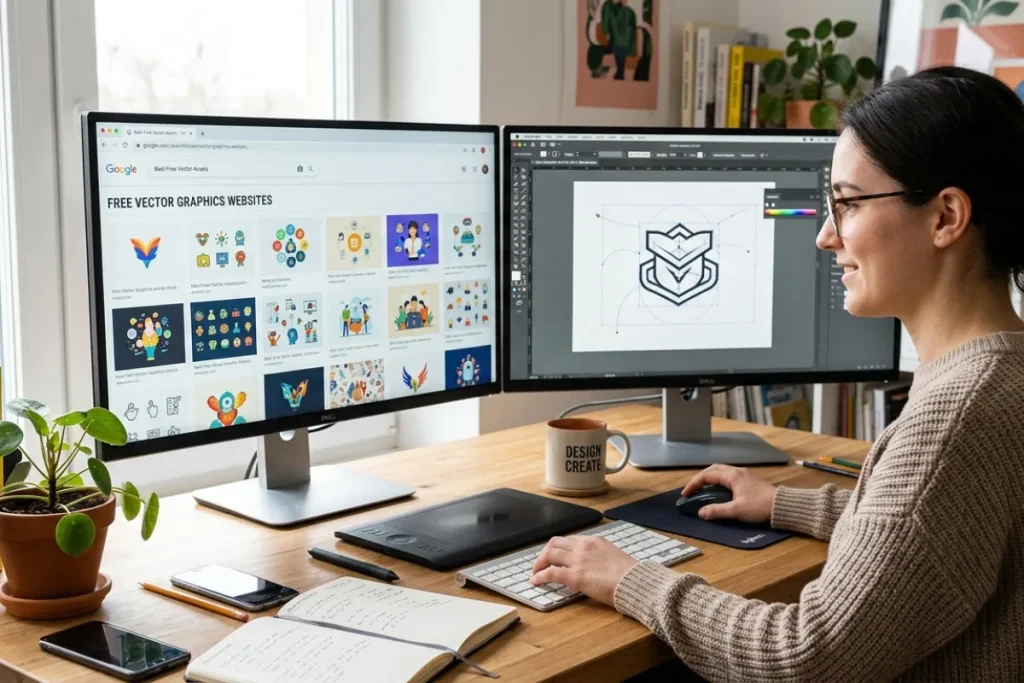
Source : Envato
Top Self-Hosted AI Models for 12GB VRAM
For the 12GB level, you seek effectiveness. You desire models that exceed their expected weight class.
Ministral 3 8B (Apache 2.0 license)
Qwen 3 8B (Apache 2.0 license)
Llama 3.1 8B Instruct (Community license)
Qwen2-5-Coder 7B Instruct (Apache 2.0 license)
Top Self-Hosted AI Models for 16GB VRAM
Upgrading to 16GB enables you to utilize models that provide a real inflection point in reasoning. These models not only chat, but they also do problem-solving.
Ministral 3 14B (Apache 2.0 license)
Microsoft-Phi 4 14 B (MIT license)
OpenAI gpt-oss-20b (Apache 2.0 license)
Llama 4 Scout 17 B Instruct (Community license)
Top Self-Hosted AI Models for 24 GB+ VRAM
With an RTX 3090 or 4090, you qualify for the “Power User” level, enabling you to operate models that have nearly frontier-class performance.
Qwen3 VL 32B (Apache 2.10 license)
Gemma 2 27B (by Google, Gemma Terms license)
Running Local AI Image Generators: Things to Keep in Mind
If you want to run local image generators, there are several things to consider. The first is mostly about copyright problems when utilizing image generators, encompassing both open-source AI image generators and commercial models.
The second one, as discussed in the previous section, is about your VRAM. The majority of “open source” AI models are in fact “open-weights,” allowing for local usage without relying on APIs. The essential hardware required for local AI is as follows.
8GB VRAM: Beginner 3B-7B models
12GB VRAM: Regular use 8B models
16GB VRAM: Advanced 14B-20B models
24GB+ VRAM: Power users
Consider employing Ollama (for a simple setup) or LM Studio (open-source). Local AI is designed solely for individual users. Access for the team and secured uptime necessitate a dedicated server infrastructure.
Conclusion
Evolving rapidly, open-source AI image generators offer more robust and accessible models. Each comes with its own fortes, catering to various practical applications. You need to understand their advantages and shortcomings to select the right one. It is just as crucial to apply these tools responsibly, particularly concerning the copyright guidelines or ethical issues. Seeking more AI collections? Go for Tridimensi’s unlimited access.