SPECIAL OFFER ✦ BUY 2 GET 1 FREE! ✦ ADD 3 PRODUCTS TO YOUR CART, AND THE DISCOUNT APPLIES AUTOMATICALLY!
SPECIAL OFFER ✦ BUY 2 GET 1 FREE! ✦ ADD 3 PRODUCTS TO YOUR CART, AND THE DISCOUNT APPLIES AUTOMATICALLY!
SPECIAL OFFER ✦ BUY 2 GET 1 FREE! ✦ ADD 3 PRODUCTS TO YOUR CART, AND THE DISCOUNT APPLIES AUTOMATICALLY!
SPECIAL OFFER ✦ BUY 2 GET 1 FREE! ✦ ADD 3 PRODUCTS TO YOUR CART, AND THE DISCOUNT APPLIES AUTOMATICALLY!
Ever felt like three dimensions just aren’t enough for your creative vision? If you’re wondering what is 5D, it’s a term used to describe experiences or concepts that go beyond three dimensions, often incorporating elements such as time, motion, or sensory effects. From 5D cinema to advanced simulations, it transforms how we experience reality.
Key takeaways:
In media, 5D functions as a sensory-rich format combining 3D visuals with physical effects and real-time interactivity.
Within professional design, 5D represents the addition of cost or behavioral data to three-dimensional models and timelines.
Leveraging 5D principles enables creatives to move beyond visual-only media into highly immersive, multisensory brand experiences.
Stepping Beyond the Screen: What is 5D?
When exploring what is 5D, context plays a key role in defining its meaning. You need to know if you’re standing in a physics lab, a design studio, or a high-tech cinema. To truly grasp the concept, we have to look at it through several lenses. Let’s get into it!
1. The General Idea of the “Fifth Dimension.”
At the core, the fifth dimension is a mathematical extension of the world we know. We are familiar with the 3D spatial world, and we’ve largely accepted time as the “4D” fourth dimension.
In geometry, however, 5D what is it but simply a fifth independent direction of movement? It represents an additional “degree of freedom” that allows for a level of complexity impossible within our standard four-dimensional spacetime.
In the high-stakes world of theoretical physics, 5D is a serious research framework. Models like the Kaluza-Klein theory suggest that the universe may actually possess a fifth dimension that is “compactified” or curled up so tightly that it remains invisible to the naked eye.
The goal here is unification. By using that extra dimension to explain how gravity and electromagnetism might actually be parts of the same force. While these theories remain speculative and experimental, they prove that the concept of what is 5D is rooted in rigorous attempts to map the very fabric of reality.
3. A Metaphor for Complexity and Interactivity
For the creative community, the definition shifts from physics to figurative meaning. 5D is often used for experiences that move beyond mere visuals. It represents a jump in interactivity where the “dimension” isn’t a direction in space, but a new layer of data or sensory feedback.
When we consider the evolution of digital expression, the question of what is 5D art comes to the forefront. It refers to work that isn’t just a flat image or a 3D model, but a reactive environment that changes based on time, user behavior, or external data streams.
4. 5D Cinema and Immersive Experiences
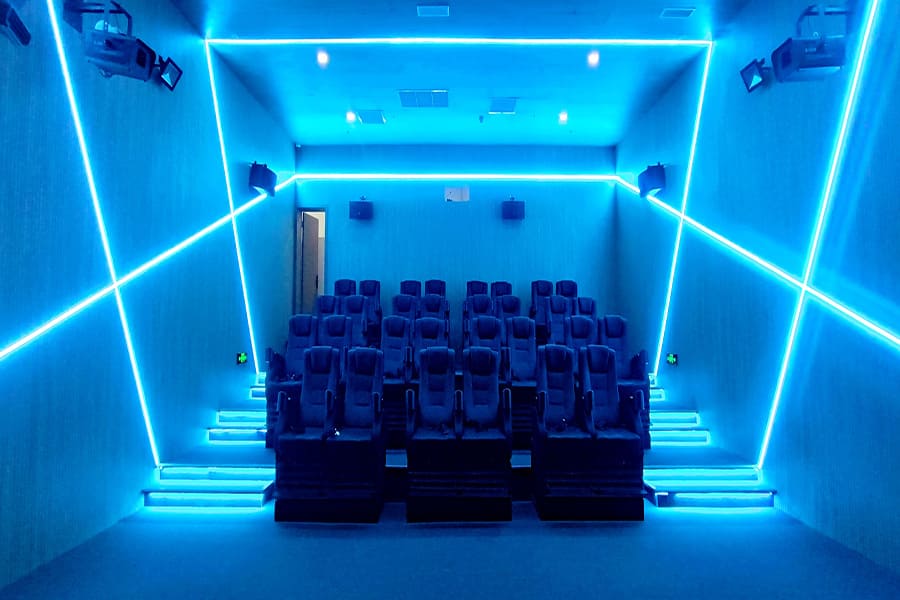
5D Cinema Seatings (Source: MoviePower)
Here, 5D is a technical label for sensory-heavy attractions. It builds upon the 3D visual and the 4D motion seat by introducing environmental effects. Think sudden gusts of wind, water mists, or even specific scents synchronized with the action on screen. In this context, 5D is essentially a count of sensory channels.
5. 5D in Design, Data, and Digital Systems
For designers and architects, 5D is a tool for managing massive amounts of information. This is best seen in “5D BIM” (Building Information Modeling), where 3D space and 4D time are joined by other parameters such as cost, behavior, or user interaction. Here, “dimensions” represent attributes like behavior, heat maps, or financial states.
6. Popular and Esoteric Culture
Finally, in various online and esoteric communities, 5D has become a symbol for a higher state of consciousness or a “frequency” of existence. While distinct from the rigid definitions found in science or design, this usage reinforces the idea that what is 5D has become a universal symbol for “the next level.”
To move beyond the theory, we have to look at how these layers of data and sensation are actually deployed in the real world. Here are the primary ways the industry bridges the gap between digital models and physical presence:
1. 5D BIM: the Financial Fabric of Construction
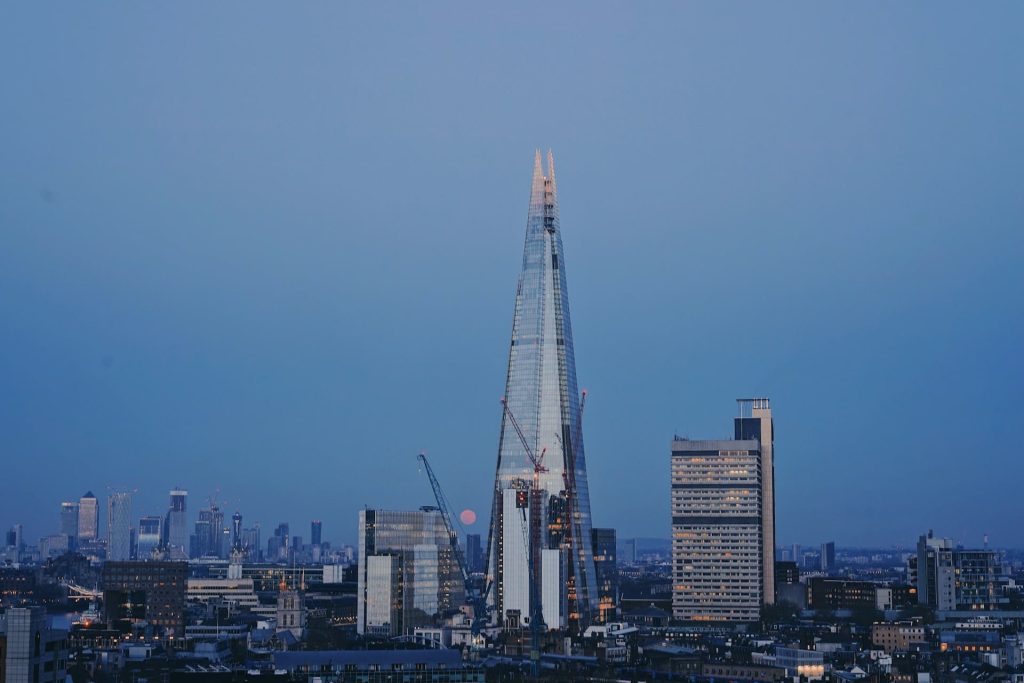
The Shard Tower (Source: Unsplash)
In large-scale architecture, 5D workflows are critical. By linking a 3D model to a 4D schedule and 5D cost data, projects such as the Shard in London and the Dubai Expo 2020 transform static designs into financially aware simulations. This is designed as a living, predictive ecosystem.
What is 5D in experimental design? The answer is 5D through the sensory saturation. Modern 5D cinemas and high-end attractions pair stereoscopic 3D visuals and 4D motion seating with a fifth layer of environmental effects. The most advanced versions even incorporate branching narratives, where the audience can affect the visual outcomes.
3. Interactive LED “Volumes” and Spatial Storytelling
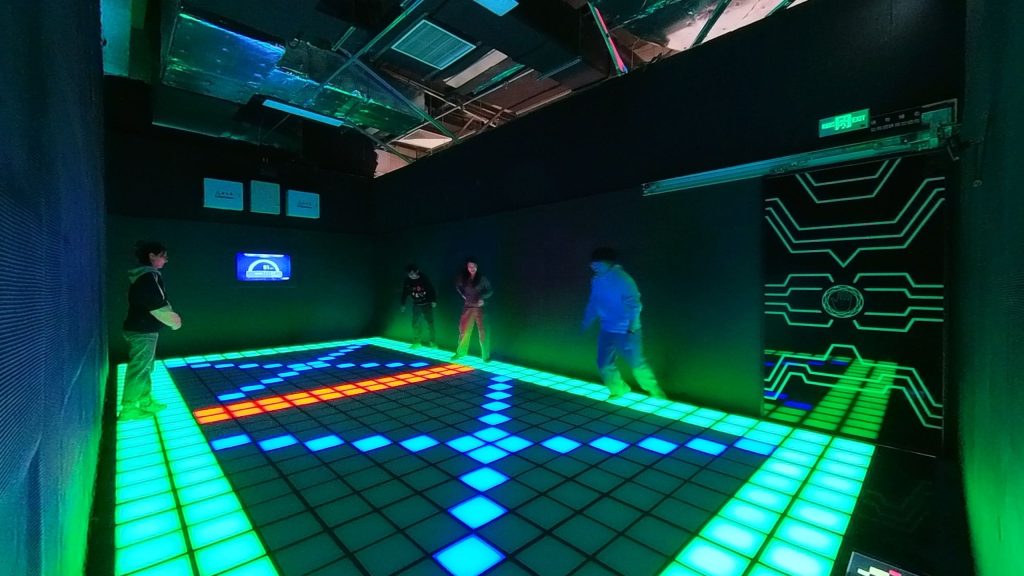
Interactive LED Room (Source: OneCraze Media)
Creatives are utilizing floor-to-ceiling LED walls and floor projections to create 360-degree environments. By adding motion-tracking sensors and tactile feedback to the spaces, the experience moves toward a “5D” level of immersion.
Ultimately, we’ve seen that 5D is far more than a technical buzzword; it represents a sophisticated leap in visual evolution. By merging space, time, and sensory data, it offers a blueprint for the next generation of truly breathtaking, immersive experiences
To start building these multi-layered realities today, consider upgrading your creative toolkit with premium assets. High-quality 3D elements from Tridimensi provide the perfect foundation for modern, attractive designs, offering the backgrounds and animations needed to make your digital branding feel truly next-dimensional.