SPECIAL OFFER ✦ BUY 2 GET 1 FREE! ✦ ADD 3 PRODUCTS TO YOUR CART, AND THE DISCOUNT APPLIES AUTOMATICALLY!
SPECIAL OFFER ✦ BUY 2 GET 1 FREE! ✦ ADD 3 PRODUCTS TO YOUR CART, AND THE DISCOUNT APPLIES AUTOMATICALLY!
SPECIAL OFFER ✦ BUY 2 GET 1 FREE! ✦ ADD 3 PRODUCTS TO YOUR CART, AND THE DISCOUNT APPLIES AUTOMATICALLY!
SPECIAL OFFER ✦ BUY 2 GET 1 FREE! ✦ ADD 3 PRODUCTS TO YOUR CART, AND THE DISCOUNT APPLIES AUTOMATICALLY!
The power of artificial intelligence (AI) in graphic design has significantly transformed how people work. AI can generate visuals from prompts, automate design layouts, and provide tools that simplify the design process with just a few clicks. This naturally raises an important question: will graphic design be replaced by AI?
Moreover, according to the 2026 Clutch Survey, 88% of businesses report using AI design tools. The most popular ones used are Magic Studio Canva, Adobe Firefly, Figma’s AI features, Midjourney, and others. However, this doesn’t mean that human designers can be fully replaced by AI. Let’s take a closer look at the explanation below.
Key takeaways:
Will graphic design be replaced by AI? No, because AI only wins in terms of speed and efficiency, while creativity, emotional storytelling, and brand understanding remain the domain of humans.
AI should be a tool to help humans streamline the design process, not to replace them.
AI vs Human Designers: What Sets Them Apart?
Check the comparison between AI and human designers below.
1. Speed of Execution
AI excels in speed, as it can generate designs within seconds. Features like Generative Fill in Adobe Photoshop can speed up the image editing process by automatically adding or removing elements. Additionally, AI can automate repetitive, time-consuming tasks.
In contrast, human designers may need hours or even days to complete a design concept. This is because the process involves research, idea exploration, and execution, all of which require careful thought and refinement.
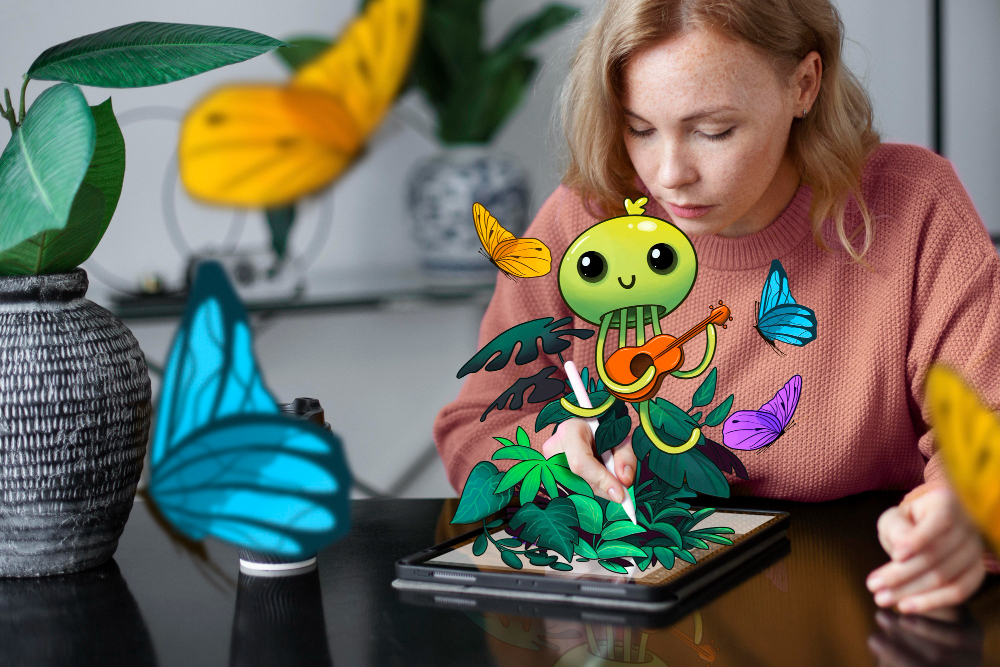
Human designer creating an imaginative character | Source: Freepik
AI works by learning patterns from existing data, so its designs are less creative since it cannot truly think outside the box. Rules and algorithms limit design outcomes, so while the visuals are appealing, they lack uniqueness.
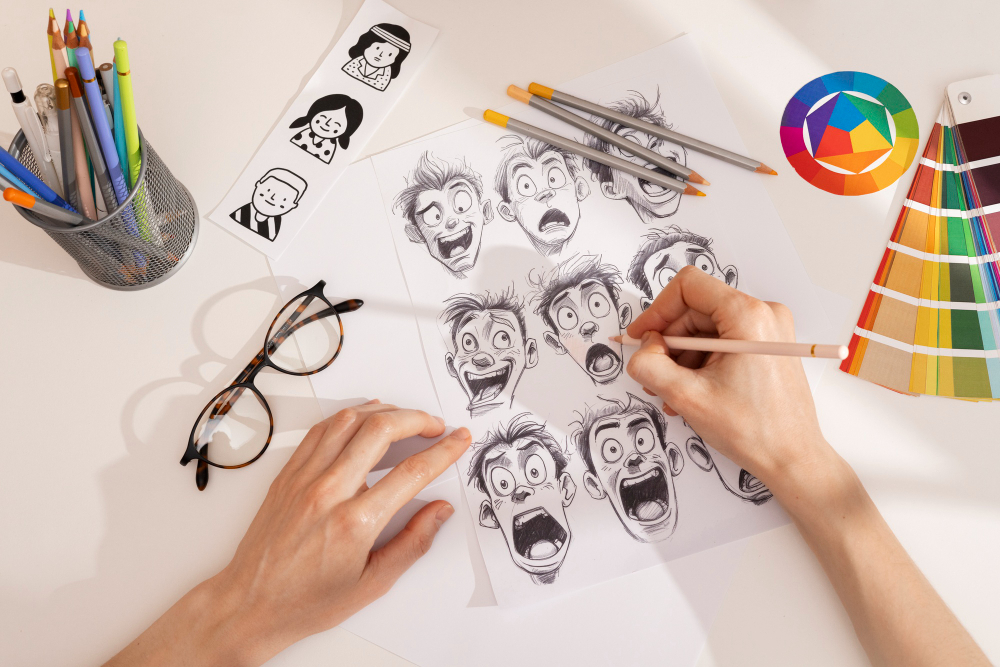
On the other hand, human designers excel in their boundless creativity. They can create original concepts by drawing from personal experiences, emotions, and abstract thinking.
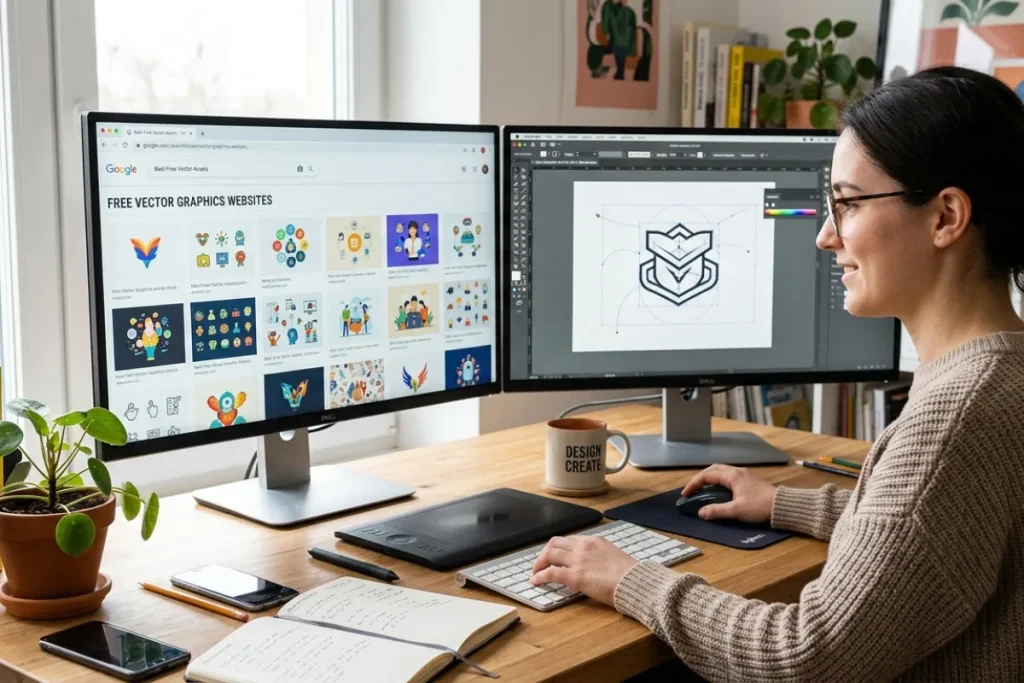
For example, when designing a logo, AI-generated results may look similar to existing designs, whereas human-created logos tend to be more unique and often carry deeper meaning or philosophy.
It is essential for a design to feature emotional storytelling to evoke certain feelings from the audience. This is AI’s main weakness since robots lack emotions, resulting in work that tends to feel flat.
In contrast, humans possess emotions, enabling them to create user-centered designs. The use of color, typography, and visual elements is tailored to the intended message, resulting in a design that tells a story that can move the audience’s hearts.
4. Problem Solving
AI’s ability to solve design problems depends on the quality of the prompts it receives. However, no matter how well it executes instructions, AI can’t think critically or handle complex problem-solving the way humans can.
Human designers have the advantage of interpreting concepts to meet client needs and adapting to feedback or revisions. They are capable of developing creative solutions to ensure the final design effectively meets its objectives.
5. Brand Understanding
AI can help brands create consistent designs, such as templates or layouts. But its understanding of brand identity is still limited to the data provided by the user.
Meanwhile, human designers can understand a brand on a deeper level, including its values, vision, and mission. This allows them to represent the brand more accurately and authentically through their designs.
No. What we are seeing today is a shift in the role of designers within the creative industry. They are not disappearing, but evolving to take on more strategic responsibilities that require creative thinking, problem-solving, and contextual judgment, areas where AI falls short.
Meanwhile, AI serves as a time-efficient tool for handling repetitive tasks such as creating design prototypes, editing visuals, and generating layouts. In fact, according to a Clutch survey, 74% of businesses report that AI has not changed their need for graphic design professionals.
So, the idea of will graphic designer be replaced by AI is simply not going to happen.
How to Stay Competitive for Graphic Designers in the Age of AI
The future of graphic design will continue to be shaped by advancements in AI. Therefore, to stay relevant and competitive in an increasingly demanding industry, do this:
1. Continuous Learning
Graphic designers need to continuously update their knowledge and skills by mastering the latest design software, along with understanding how AI works to optimize their workflow. For example, learning tools like Adobe Firefly allow users to create backgrounds and image elements quickly using simple prompts.
2. Strengthening Storytelling Skills
High-quality design is not only about visually appealing elements, but also about delivering meaningful and impactful stories. Since AI can’t fully understand human emotions, designers need to develop strong emotional storytelling skills to connect with their audience and evoke empathy.
In the end, the question “will graphic design be replaced by AI” is unlikely to happen. Rather than viewing it as a threat, AI should be seen as an assistant that helps automate repetitive tasks. The collaboration between human designers and AI can lead to creative, emotionally engaging designs produced in a shorter amount of time.
Additionally, you can enhance your visual projects by utilizing premium 3D assets from Tridimensi. With collections ranging from 3D animations and 3D fonts to 3D shapes, these assets can help you create more competitive and visually compelling designs.